A transition driven by the urge to establish a Circular Economy, powered by the potential efficiency and effectiveness offered by digital technologies, needs to be grounded on a new set of knowledge and skills provided through updated higher education (HE) and vocational education and training (VET).
CERES recognizes the need to shift the narrow focus of CE from businesses to a broader and systemic perspective capable of considering the skills, competences, and knowledge needed to be incorporated into HE and VET curricula.
Research shows that promoting the cross-fertilisation of key technological disciplines with circular economy (CE) concepts and notions has significant potential to address the complex challenges hampering the path towards a more sustainable and resilient society.
The ambition of the CERES project is to initiate the adoption of the CE model from a social development perspective, commencing with the early stage of education and training.
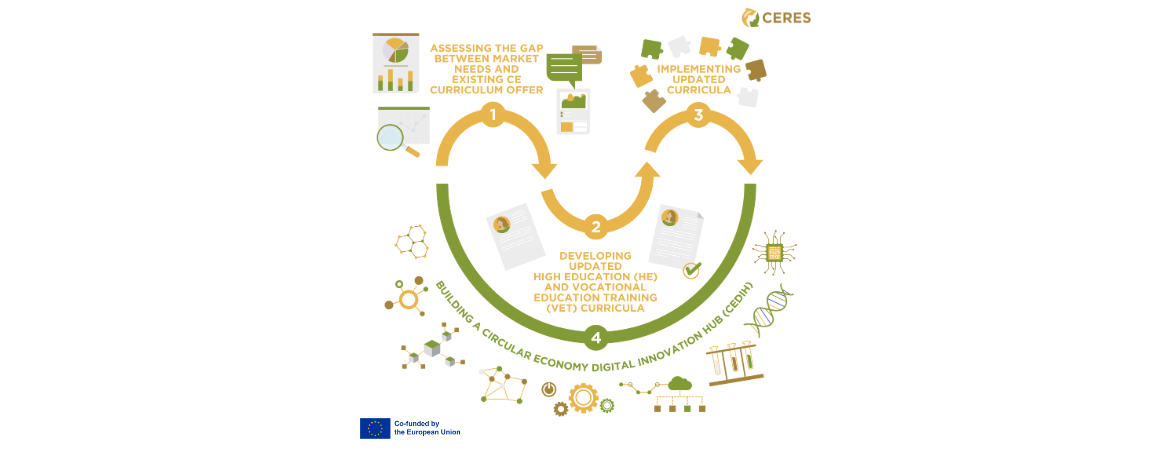
In collaboration with a combination of different partners, CERES aims to develop well-structured, result-driven education initiatives and training curricula, built on both an analysis of the market needs for new competences and an evaluation of learning material from existing courses on CE.
The connection between the current manufacturing and industrial system with the visions offered by the Circular Economy model still needs to be reinforced in Europe. CERES aims to foster a collaborative effort among stakeholders from various ecosystems to drive the transition toward CE through the exploitation and adoption of digital technologies.
Within this context, the CERES innovation ecosystem, formally embodied in the Circular Economy Digital Innovation Hub (CEDIH), strives to encourage dialogue among stakeholders and establish a structured set of services, skills, competencies, and knowledge to support the multifaceted CE model.